
Duel of the Dorks
This 7-minute epic takes the audience through a multitude of locations as a couple of dorky theater employees battle it out over a coveted movie poster... and takes third place in the contest while they're at it.
Production
The Idea
In the summer of 2009, while Tim Sazama worked at the bowling alley in Norfolk, Leigh Stoffer and I both got jobs at the movie theater right next door. Since I had worked at the bowling alley with Tim back in high school, and the three of us having referred to ourselves as the Trio of Doom off and on over the years, it is no surprise—looking at the location of Duel of the Dorks—that we had wanted to shoot a film here for a long time. This particular summer though, talk began amongst theater employees of having a lightsaber showdown that incorporated the whole building.
As such, Tim and I began developing the idea in more detail. Occasionally throughout the summer, we would see a movie and then wander through the building, pointing out cool locations and neat ideas. The two big ones that made it through to the final film were the brick pillar destruction and the pin setter sequence. We often joke that the entire film hinged on one gag: having the pins reset with a lightsaber hilt in the front. Other than that, we had a rough idea of where the fight would go, and quite a few very ambitious ideas that never made it to being shot. But as usual, life intervened and things got put on hold for another winter.
No Seriously, Let’s Do This
By May of 2010, the eighth Lightsaber Choreography Competition launched, and Tim and I decided we were finally going to stop talking and start doing. We started choreographing, and a few days later, Tim sprained his ankle. Things got put on hold a bit while he recovered, but I continued to ponder how we would go about shooting everything. It was decided that we would borrow Alex Jeffery’s HVX200 once we needed it, as he wouldn’t be using it much at all during June. In the meantime, I met Emily Kreutz, a recent graduate of the audio recording program at Northeast Community College, who was working for her professor/my former boss. She expressed interest in wanting to shoot a lot more video and film projects, rather than strictly doing audio. As such, she would become our primary camera operator. Shortly thereafter, I ended up putting my notice in at the theater, but the manager, Darrin Paul, was gracious enough to allow us to shoot even after my employment ended.
An Intense Week
The first day of shooting began with some hiccups, which included my car breaking down on the way to pick up Alex’s camera, flooding causing my brother and I to detour around large chunks of the trip, and just generally freaking out on my part as I made sure I had everything I needed. The first night seemed to start off pretty slowly too, since we had theater employees bugging us as we prepped, and introductions to be had, as it was the first time everyone including Emily was together and actually working on something. And to be honest, a lot of things weren’t thought out in as much detail as it could have.
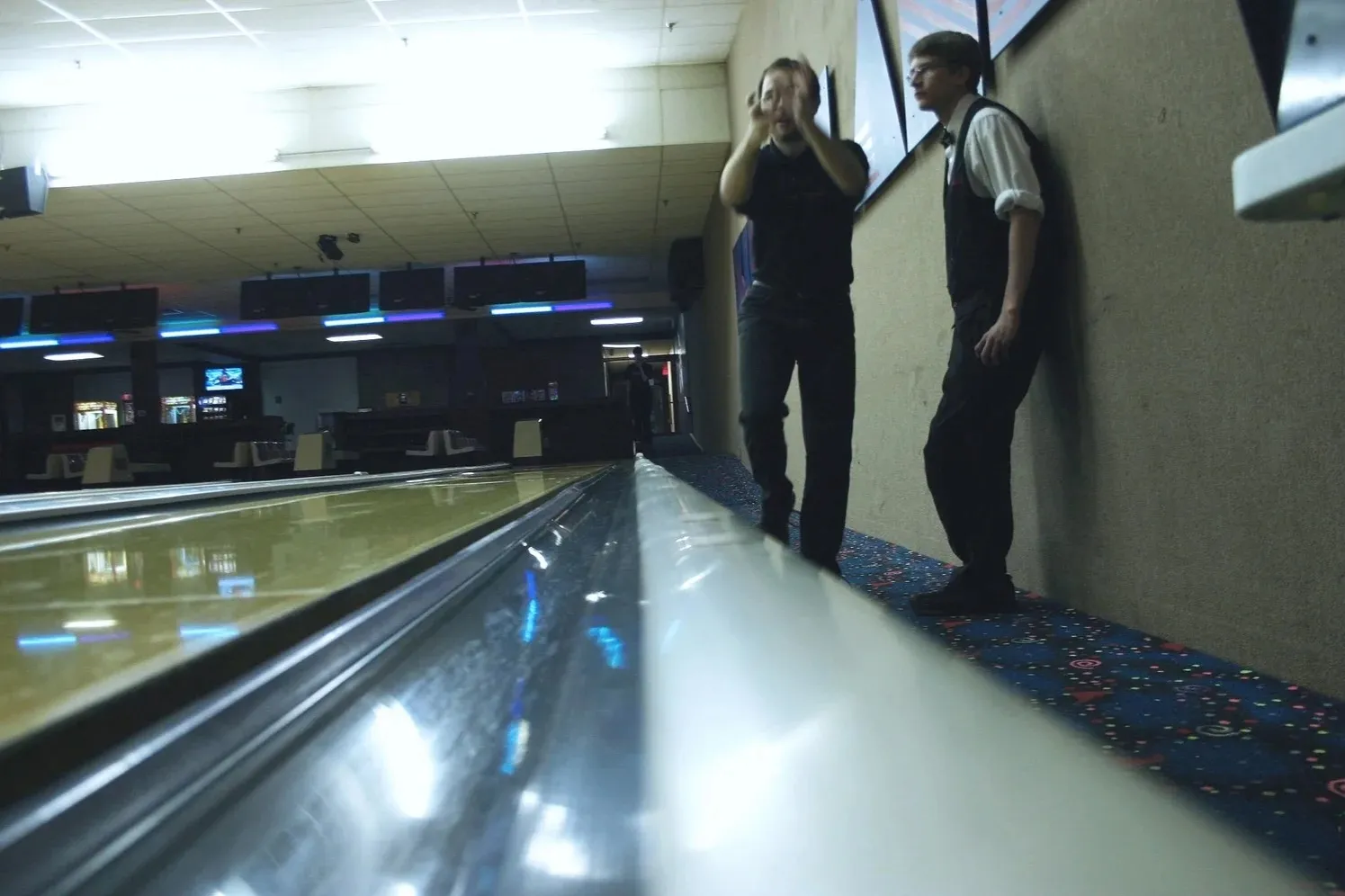
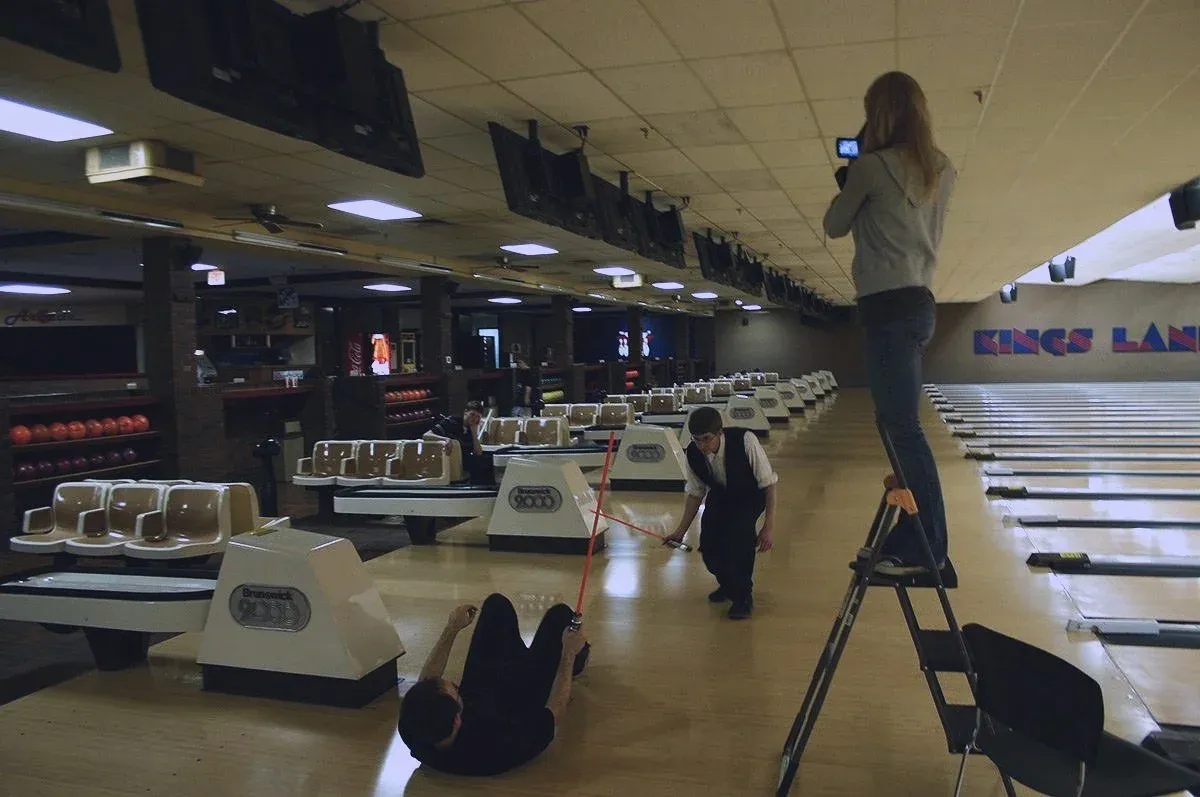
By the end, it was quite a success. Darrin even let us shoot until we were finished at the theater. We had intended to be done by 11:30 or midnight, when the projectionist would leave. Instead, we shot until 2:30 in the morning, with Darrin watching the whole time and seeming to rather enjoy watching us work. The rest of the week was an exhausting one as we moved into the bowling alley, occasionally having to switch camera operators when Emily couldn’t be there. My younger brother, Jeff, filled in for a good portion of the film, as did Chris Behlers in later reshoots. And anytime I wasn’t in a shot, I would man the camera. Each night we would stay up well beyond our end of the shoot and extend the cut of the film a little further. The following night would then start with a handful of reshoots based on notes from the previous editing session.
During the middle of our first week of shooting, I had to return to Lincoln to allow Alex to use his camera for a day. While I was there, the Elkhorn River, which flows just south of Norfolk, decided to unleash a 500-year flood. This more or less trapped me south of a certain point in Nebraska. I eventually had to simply drive through Omaha and into Iowa to get around the Elkhorn, which put me back in Norfolk just late enough that it wasn’t worth shooting. But the upside was that Alex wouldn’t need his camera back for a few weeks.
Editing
It’s a Lock! …or is it?
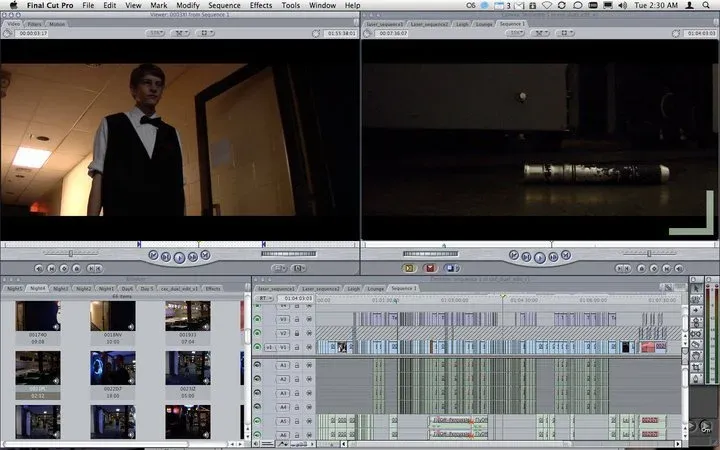
After a week and a half of shooting with a few missed nights here and there, we had what we considered a locked edit, and began working on the visual effects. The more we watched it though, the less and less confident we were in the second half. Around the five-minute mark, we cut away from the duel to introduce Leigh. She discovered a mess we had made in the employee room where the duel started, and then followed our path of destruction through the building and eventually interrupted the imaginary duel by grabbing my lightsaber and chopping my head off, then revealing (in one continuous shot, via a carefully executed handoff) that the saber was a poster tube, and I was fine. We started tearing the film apart and pointing out to ourselves how little sense anything made:
- The fight was in the imaginations of Tim and myself, therefore none of the destruction was real, thus Leigh wouldn’t have anything to see/follow.
- There was no precedent setup to warrant cutting away from the duel, making the 5-minute mark jarring and confusing.
- The fight needed to continue uninterrupted until Leigh intervened.
- Given point #3, we needed to establish Leigh’s character in the opening.
- Points 1-4 meant we had many o’ reshoots ahead of us.
Restructuring
We first started to fill in the gaps that were present where we cut away from the fight. This ultimately meant more than simply filling in between shots. It meant trashing several minutes worth of the film and re-choreographing and reshooting everything from when I came out from the pits to a new entrance into the lounge. The ending was also extended slightly now that we had more days to shoot in the lounge. So from the moment Tim fell onto the pool table to the credits was entirely new. I was extremely grateful that Leigh agreed to this entire restructuring of the film, as it required much more involvement from the “only one night” we promised her in the beginning. She was also helpful in working out the dialog and even offered the idea that we just end up crawling on the floor by the end.
The very end of shooting was the most nerve-wracking. Alex absolutely needed his camera back by a certain day, and we were having a hard time getting permission to reshoot the theater opening. It came to the point that Alex and his DP, Brian Watt, were on their way to Norfolk to get the camera, while offering to shoot the scene for us as long as they could hit the road by a certain time. Luckily, the person supervising at the theater that night was David Hans, Leigh’s cousin. He allowed us to shoot at the last minute, and we scurried through.
By this point, the film had been edited entirely minus the new opening, and positioning the very last frame at the 7-minute mark (our time limit for the contest), we realized we had a mere 40-seconds to open the film and seamlessly cut into the first shot of actual saber action. The dialog was written to be very short; nearly one word lines, which also helped display Leigh’s annoyance with these two dorks, who likely have had other lightsaber battles at work. Tim and I worked out the scene with some acting direction from Alex, and Brian shot the crap out of it. I in fact didn’t even bother giving direction for the camera or reviewing shots. I trusted them enough so that we didn’t get to see the footage until I ventured down to Lincoln the following week to fetch it, as there wasn’t enough time that night to dump footage.
We managed to squeeze the opening into 60 seconds, which pushed us 20 seconds over the time limit. But we then used that as an opportunity to find 20 expendable seconds elsewhere in the film. Our composer, Justin R. Durban, assisted in this area, giving a few great moments where we could cut chunks of choreography out and make two shots that were separated before actually flow together. In the end, it resulted in a tighter, cleaner cut, and I was very happy to cut what we did. Without going 20 seconds over, I’m not sure we would have taken the initiative to do so.
Sound Recording
Duel of the Dorks presented us with a situation we are not generally used to, in that we had continual access to the bulk of our location. The bowling alley was usually open for us to return for quick pickups, and when we needed to record foley, we were able to simply record things in the actual environment. We borrowed a Sony NX5U from Digital Solutions in Norfolk, (which was where we were editing and doing the VFX anyway) along with a shotgun mic and a wireless lapel mic that we could place in interesting locations. Feeding each into an XLR port, we could record two vantage points into different channels from whence they would be separated and remixed if needed later.
Tim and I actually had a blast spending four or five hours moving through the location again, armed with the cut of the film on a laptop and recording every little sound that wasn’t lightsabers. The shop in the back of the bowling alley proved most useful. One would have found us there for a good half-hour throwing things on the ground until we found a good lightsaber hilt sound, seeing as the actual props sound like what they are: hunks of solid aluminum. We eventually settled on two pairs of vise-grips (a small one and a large one), and proceeded to drop them on the ground, slide them down the lanes, pick them up, catch them… anything we did with the props on screen.
Placing the lapel mic in interesting places proved quite useful. The moment I come out from the pits and Tim is waiting for me, we recorded the creaking door by clipping the mic onto the hinge itself, and then just letting the door swing back and forth. The amount of times it swung back and forth was actually quite funny, but we trimmed it down to match the visual. We also did a number of recordings in the lounge by placing the wireless mic inside of the pool table, and then proceeded to drop the vise-grips, poster tube, cap and Tim on top of it. This added some nice bass to these sounds.
The best part of recording everything later was the happy accident in the opening. I was rigging the lapel mic onto the handle of the door that Leigh opens at the very beginning, and as Tim listened with the headphones, he discovered that we were picking up an amazing howling from the wind whipping through the entryway right outside the door. So we recorded a bunch of this wind and used it as our opening sound. We also ended up picking up some bowling sounds down the hall, so we kept that in there to clue the audience into the fact that it wasn’t just a movie theater. Some of this wind was also mixed in when the fight moves into the entryway, but it is quite subtle once the music is layered in.
All of the dialogue was also recorded later, at Digital Solutions. Although being my first time trying to really do ADR well, I feel it could have been better. By this point, we didn’t have precise enough scheduling to go out to the college and record it properly like I would have liked. But the whole experience was quite fun, as Tim and Leigh and I can never stay serious, resulting in several minutes of goofy recording.
Score
Justin R. Durban is a fantastic composer whom I met in 2008 while working with Fat Monster Films. We have since remained in contact and worked together on a few projects. Early in post production, I began cutting things together with Pro Scores. I had intended on asking Justin to do a score for Alex vs Nate 2 later, so I didn’t ask this time. However, after seeing various production photos on Facebook, Justin shot me a message and offered to write a score for us. The result was more than I ever could have imagined, and really gave the film that final bit of polish we needed.
Visual Effects
We began planning the visual effects process for Duel of the Dorks before choreography even started. As we had originally intended on shooting Alex vs Nate 2 during the same summer, I knew there were going to be a lot of lightsabers to roto. As such, I contacted the 20 or so artists who worked under me on Ryan vs Brandon 2 and asked if they would be interested in helping me again. A handful of them jumped at the chance, which gave us the confidence that we could finish all the visual effects on time. The overall process of the effects was probably the smoothest of anything on the film. The only real hiccup was how much the edit kept changing as we started restructuring, which forced us to keep updating the shot list and coming up with new naming conventions for each new sequence we were adding. The artists were basically allowed to pick and choose their shots, as they were on RvB2. Anything leftover I either assigned according to their availability or went ahead and rotoed myself.
Workflow
Every VFX shot in the film was sent directly from our Final Cut Pro timeline to Apple Shake. I had initially planned on doing everything in Shake, but later switched to After Effects. The amount of paint fixes required, however, still made it worthwhile to simply send to Shake, as I find paint fixes much easier in a node-based environment. Shake would then reference the original ingested plate (the same plate FCP was looking at), at which point I could do whatever paint cleanup required, and then render tiff plates for use in the final comp in AE. This spared us one render between FCP and paint fixes at least.
For the lightsabers, we followed our workflow for RvB2 by which all the artists rotoed in After Effects and then sent me project files. I then used a pre-built comp driven by expressions (the same comp I developed and used on RvB2) to apply the glows and then added contact flashes and other elements as needed. For those who wish, you can download the lightsaber comp that we used here.
The finishing touch on each shot was adding dirt to the lens. I grabbed the dirty lens plates from Optical Flares and comped them on top of the final shot, using the contact flares as a luma matte to determine where and when the dirt shows up. On key close-up shots, however, I also had the lightsaber blade itself illuminate the dirt.
Destruction
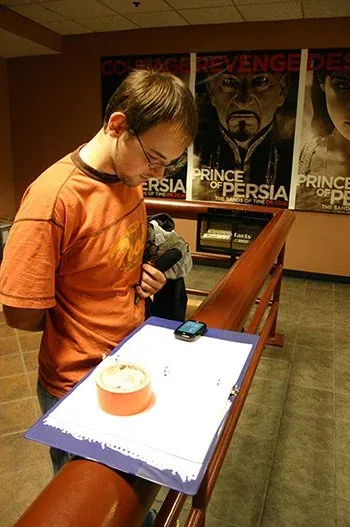
As we indicated early on in the duel, we wanted to do more environmental interaction than we had done before. We knew early on that we wanted to chop up the railing in the theater lobby, and this proved easier than I anticipated. We marked off the spots where the cuts would occur using orange tape. This gave me something to track so the cuts would stick. However, the shots in question didn’t move too much, which made it easier. Once I had tracking data, the tape had to be removed. I repainted the railing so it looked like new. Next, I patched in the background that would be seen behind the cut using clean plates that Emily shot on set after each take, which she achieved by simply very carefully moving the camera above and below, or left and right of the railing. I figured it out from there. Of course the angle that each cut was displayed rendered most of this clean plating rather moot.
I ended up simply painting the cut by hand in Photoshop. The inside of the railing was rendered with a very dark oval shape and a little lighting painted into it. The rough edges were then painted with some rough brushes. Heading over to After Effects, I duplicated these edges and blurred them, adding them onto each other, not unlike a lightsaber. This gave the molten metal look, which I then animated to slowly fade as if it was cooling. Throw in some sparks compliments of Bob Forward and you have yourself a lightsaber-chopped railing!
Shot 57 - Pillar Destruction
Sometime in the midst of post production, Kevin George, who was one of the artists on RvB2, contacted me to see if I still needed help on DotD. I did indeed, and he assisted in a bunch of lightsaber roto. As it turned out, he had been one of the first to respond to the call back in May, but I had simply missed his email. While viewing our latest cut with some of the incomplete VFX shots, he noted my current rendition of shot 57, and offered to take a stab at a FumeFX simulation. I was totally psyched, having already asked another artist to try FumeFX, but their system not being able to handle it. I was mostly having trouble with the matchmoving, which Kevin proved to be exceptional at doing. He sent me a few style frames for what he imagined the gash would look like, which I loved, and then he set off to work.
Over the next few weeks, we worked out the amount of debris that flew at Tim, the amount that fell to the floor, and at least a solid week just dialing in the smoke. My favorite moment was when I gave him the full-body roto for myself, and he used it to allow me to walk through the smoke. Shot 57 ended up being our very last shot to be rendered and put into the film. I expressed at the time how I was kicking myself for missing his initial email, as we could have had all summer to perfect the shot instead of three weeks. Regardless, it is my favorite shot, as is surely evident by my frequent use of it around the internet in reference to the film.
Shot 66 - Matchmove Nightmare
We had a number of scorch marks throughout the film, mostly on walls. Some proved very difficult. Shot 66, which is the overhead shot as Tim does a kip-up over my lightsaber, was one of the most difficult matchmoves in the film. The effect was also crucial. Without the scorch mark, the shot makes little sense as to why we went with an overhead angle. The whole point was to burn the approach and show it off. Kevin fought with the tracking for some time. The first fault was mine. I was so caught up with the shoot that night that I failed to put down any tracking markers, leaving Kevin with very few features to track. He also had little information as to where the camera was other than “above.” This is where my younger brother, Jeff, saved the day.
When we were filming this particular shot, he just so happened to have walked around and taken pictures of us from several angles, almost covering 360 degrees. There were a couple shots Jeff took at just the right moments that allowed us to match them up with specific takes. In one, I swung too fast and smacked the front of Tim’s feet. Jeff snapped a photo at that very moment, so we were able to pair that with a certain take. In another, he took a picture at the end of the take, and looking at our positioning, we were again able to match it. This allowed us to determine which photo was taken on the take that was in the film, showing us how high Emily was holding the camera. I then took these photos into Image Modeler, where I was able to start triangulating points around the set until we had a full calibration of the scene. With this calibration, I could tell the computer that the width between two points on either side of the lane was 42″, and from there, I could measure anything else in the scene.
I set a point at the camera and was able to determine that the camera was about 7 feet off the ground. This helped dial in the camera solve a little more, but not quite. Because the features that Kevin was trying to latch onto moved in and out of the shot, the software was having a hard time keeping track of them. So I ventured back to the bowling alley and took reference photos from various heights that showed more of these features. I more or less went back and retook the shot using stills, but just tilted the camera up a little more. I took other heights “just in case.” Kevin was able to feed these into Syntheyes and create a successful camera solve, finally sticking the scorch marks onto the ground after I fought with it all summer.
Bob Forward
If you still haven’t heard of Detonation Films, run, don’t walk, and check them out. The owner of the website, Bob Forward, previously helped me with stock elements by filming fire specifically for our shots on Movie Spoof 3. Later, he worked with Ryan Wieber and Michael Scott, filming all of the spark elements needed for Ryan vs Dorkman 2. For Duel of the Dorks, we were able to do quite a bit with purchased collections from Bob, but we had a few oddball shots that simply wouldn’t be found on a stock footage site.
Specifically, we needed sparks filmed from overhead, one set for when I slash through the railing, which Bob provided with ease, and another for shot 66. The latter, however, took a few tries to get something that worked. Because of the arc and speed of the saber, it was hard to get strips of sparks to fire off and match. In the end, Bob simply set off individual charges that I could then place on the 3D floor and control the timing. Of course, all this work simply resulted in my brother Jeff saying “NO SPARKS!” every time we watch the film. But I think it looks cool.
Bob also shot a small section of a carpeted wall on fire that we could use in two shots later in the duel, where Tim does the backward arch (which was unassisted, BTW; I kinda wish we had stayed wide to show off his skills) and then turns on his saber and slices the wall. This effect used a photograph of carpet/wood/concrete layers which was “burned” in Photoshop and tracked in with Kevin’s painstaking matchmoving (the wide shot was nearly as difficult as shot 66). This was another effect I was worried about but immensely happy once it was successfully finished.
Use The Force!
We used a handful of tricks to move objects with the force. In the opening, I summed the purple lightsaber by means of a fully animated CG lightsaber that was modeled, textured, animated and lit by Ben McEwan. Later, the same lightsaber was again fully animated by Ben and Kevin when Tim threw it at me and tripped me with it (one of the lesser successful moments in the duel, which was the fault of our lack of planning on set; the animators were superb). Shortly after these shots, I summon the orange lightsaber only to have it stopped by the rake; this part was entirely wire work and the real prop, with paint work done by Steve Ernst and myself.
In the lounge, when I point at the cue ball and direct it to Tim’s face, it is a 2D effect in both shots. We shot a plate of the pool table, and then shot video circling the cue ball where it is supposed to be, in case we needed to go 3D. In the end, I simply grabbed a screenshot at the appropriate angle, recreated the shadow under it using a couple of roto shapes, and quickly animated it to fly off screen. For the shot of Tim, I used a view of the ball from the other side and animated it until it felt about right. This same technique was used in Alex vs Nate, when my saber flies into the air and Alex yanks it away with the force.
The final object that was animated wasn’t because of the force, but because the real shot didn’t quite do what we wanted. When I smack the purple lightsaber out of Tim’s hands at the end, we managed after a few takes to get it to spin exactly how we wanted, but it simply spun and fell straight down. We wanted it to fly across the room. So I ended up rotoing the saber prop off the shot, cleanplating the wall where it was, and then recomping the prop and animating it to fly off screen left as it spun, giving us the desired effect and consistency with the next shot.
Roto & Paint
Throughout the film, there are a number of paint fixes, from very quick and easy to days of work. Everything I mention here can be seen in the video breakdowns above. For instance, we had to remove the Prince of Persia banner in the opening of the film because that shot was done months earlier than the rest of the opening, and we had more shots of it gone than there. So rather than add it back into other shots, we removed it from the oddball shot.
The shot where I throw Tim down the steps (which was an accident) was actually a pickup shot very late in production. We had been doing a few reshoots in the lounge while they were open one day, and decided we would quickly reshoot that particular moment. But we didn’t think about the fact that the TVs were still on. This created several days of work on my part. I not only had to track black screens back onto the TVs, but I had to paint out all the lightwrap from the motion blur due to the camera move. Since light streaks the way it does, this required actually filling in information between the TVs. There was a second shot filmed that day, but since the pickups were at 1080p on the NX5U and the rest of the film was 720p on the HVX, we could simply crop the TVs out of the shot.
On the approach, when I swing down and try to hit Tim while he’s on the ground, we again ran into problems since it was a pickup shot. We had been filming the opening, and then came next door to get a few reshoots before Alex and Brian left, so I still had my bow-tie on and the orange lightsaber in my hand. Once we realized this, we were out of time and couldn’t film it again, so it became a paint fix. Much of the bow-tie was removed by hand, frame-by-frame. The lightsaber was replaced rather easily by taking a front view of the correct saber, which we had from the reference pictures I took for Ben, and simply color correcting and animating it in carefully. If you look close enough, you can see that I comped the saber into the reflection in the floor, but I forgot to flip it. Oops!
There were few quick paint-outs here and there where we needed to remove the lightsaber prop blades temporarily for activations and retractions. We chose to shoot with prop blades in several cases since we had actual fighting interaction in the same shot. If there wasn’t any interaction, or the interaction was very minimal, we shot with the hilt only and I animated the blade completely. Once we found a good technique, we found this approach to be rather easy to pull off, as we displayed in our teaser trailer:
The final note-worthy paint fix was yet another pickup shot in the lounge. I was particularly proud of the fact that my brother Jeff managed to pull off the camera move I was asking for. It was definitely a complicated bit of choreography between my trying not to hit the light, Tim, or the camera, and then the camera needing to move over my lightsaber at the end, and all needing to look spontaneous. The one bit we couldn’t manage to play into this little dance however was getting the projector turned off in the background. The fix involved a roto shape to define the projector screen, and then layering in a gray tone with a little bit of a gradient for proper lighting, then matching the grain. After that, I had to hand-paint every motion blurred edge that passed in front of the originally-lit screen, which included a decent amount of hair. Aside from the projector screen, my lightsaber bent as I pressed down on the pool table, and as a result needed to be removed for most of that segment of the shot. But after years of filming lightsaber duels with aluminum blades, I was quite used to this part.
Premiere
Duel of the Dorks premiered online in September 2010 as part of the Lightsaber Choreography Competition. That day, the guys at Friends in Your Head, who were the judges for the contest, hosted a live show where they gave commentary and critiques of every entry. There was also a lively chat room going the entire time. Check it out below!